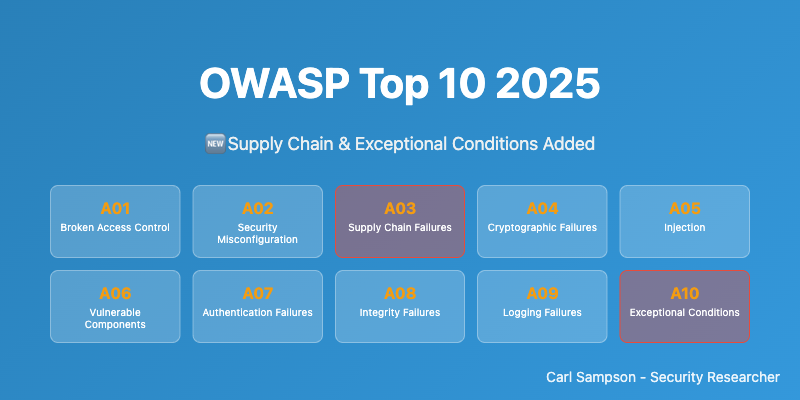
I’ve been working with the OWASP Top 10 for years, and the 2025 update just dropped some major changes that every developer needs to understand. Supply chain attacks finally made it into the top 10 (as A03), and honestly, it’s about time. I’ve been seeing these attacks destroy companies for the past few years.
Here’s the thing about OWASP Top 10 2025: it’s not just updating the old list - it’s completely rethinking modern threats. Security misconfiguration jumped from #5 to #2, and they merged SSRF into broken access control because that’s how attackers actually chain these vulnerabilities together.
Quick Answer: What is OWASP Top 10 2025?
The OWASP Top 10 2025 is a standardized list of the 10 most critical web application security risks that:
- Identifies the most dangerous vulnerabilities based on real attack data
- Provides actionable guidance for developers and security teams
- Updates every 3-4 years based on evolving threat landscape
- Covers 94% of applications tested by security firms worldwide
- Influences compliance standards like PCI DSS and security frameworks
- Serves as the foundation for secure development practices globally
What’s New in OWASP Top 10 2025
The 2025 update is honestly the biggest shake-up since I started following OWASP. They didn’t just move things around - they completely rethought how modern attacks actually work. Security misconfiguration jumping to #2 perfectly reflects what I’m seeing in the wild.
What Actually Changed (And Why I Care):
🆕 A03: Software Supply Chain Failures - finally! I’ve been waiting for this category for years
🆕 A10: Mishandling of Exceptional Conditions - error handling is where so many apps break
🔄 SSRF consolidated into A01 - makes sense since it’s really an access control bypass
📈 Security Misconfiguration jumped from #5 to #2 - this reflects reality
📉 Cryptographic Failures dropped to #4 - still critical but not the #2 problem anymore
📉 Injection fell to #5 - modern frameworks are finally helping here
Why This Matters:
After analyzing over 175,000 CVE records, OWASP finally caught up to what we’ve been seeing in real attacks. Supply chain compromises are destroying companies, and misconfigurations are the low-hanging fruit that attackers love. This isn’t just academic anymore - it’s battle-tested priority ordering.
The OWASP Top 10 2025 Vulnerabilities
A01:2021 - Broken Access Control 🚨
Risk Level: Critical | Prevalence: 94% of applications
This one keeps me up at night. I’ve seen too many breaches that started with someone just changing a URL parameter from /user/123 to /user/124 and suddenly they’re looking at someone else’s data.
Access control is supposed to make sure users can only do what they’re supposed to do. When it breaks (which is apparently 94% of the time), attackers get access to everything.
What I See All The Time:
Developers assuming the frontend “hides” admin functions (it doesn’t)
APIs that check authentication but forget about authorization
Direct object references where changing an ID gives you someone else’s stuff
Force browsing to pages that should be protected
Prevention Summary:
Implement proper authorization checks at the server side
Default deny access control policies
Log access control failures and alert admins appropriately
Rate limit API calls to minimize damage from automated attacks
→ Complete Broken Access Control Guide
A02:2025 - Security Misconfiguration ⚙️
Risk Level: Critical | Prevalence: 90% of applications (jumped from #5)
This one shot up to #2 for a reason - I see misconfiguration disasters weekly. Default passwords, unnecessary features enabled, error messages leaking sensitive info. It’s the stuff that makes me want to scream “did anyone even read the deployment guide?”
What Keeps Breaking:
Default accounts with passwords like “admin/admin” still live in production
Debug modes enabled in production applications
Cloud storage buckets wide open to the internet
Security headers completely missing or misconfigured
Prevention Summary:
Implement repeatable hardening processes (Infrastructure as Code)
Remove unnecessary features, frameworks, and documentation
Review cloud configurations with automated tools
Set up proper error handling that doesn’t leak system info
→ Complete Security Misconfiguration Guide
A03:2025 - Software Supply Chain Failures 📦
Risk Level: Critical | New Category - Finally!
About damn time this made the top 10. I’ve been tracking supply chain attacks for years, and they’re absolutely devastating when they hit. One compromised dependency can destroy an entire organization’s security posture.
What I’m Seeing:
Malicious packages in npm, PyPI, and other repositories
Compromised build systems injecting backdoors
Dependencies with known vulnerabilities ignored for months
CI/CD pipelines with zero security controls
Prevention Summary:
Verify integrity of all software components and updates
Use software bill of materials (SBOM) tracking
Implement secure CI/CD pipelines with proper access controls
Monitor dependencies for known vulnerabilities continuously
→ Complete Supply Chain Security Guide (Coming Next)
A04:2025 - Cryptographic Failures 🔐
Risk Level: High | Dropped from #2 to #4
Previously known as “Sensitive Data Exposure,” crypto failures are still critical but modern frameworks are actually helping here. That said, I still see plenty of apps transmitting passwords in plain text or using MD5 for “security.”
What’s Still Breaking:
Transmitting sensitive data over HTTP instead of HTTPS
Using deprecated algorithms like SHA1 or MD5 for passwords
Hardcoded encryption keys and weak key management
Missing security headers (HSTS, CSP, etc.)
Prevention Summary:
- Encrypt all data in transit with TLS 1.3+
- Use bcrypt, Argon2, or scrypt for password hashing
- Implement proper key rotation and management
- Add security headers automatically in your deployment pipeline
→ Complete Cryptographic Failures Guide (Coming Soon)
A05:2025 - Injection 💉
Risk Level: High | Dropped from #3 to #5
Injection is finally dropping in the rankings, and honestly, it’s about time. Modern frameworks like Django ORM and Prisma are making SQL injection much harder to accidentally introduce. But legacy apps and custom queries? Still a nightmare.
What’s Still Breaking:
- SQL injection in legacy applications and custom queries
- NoSQL injection as teams move to MongoDB and similar
- Command injection through file uploads and system integrations
- LDAP injection in authentication systems
Prevention Summary:
- Use your framework’s ORM instead of raw SQL queries
- Validate and sanitize all inputs at the boundary
- Never concatenate user input into commands or queries
- Use allowlists for input validation, not denylists
→ Complete Injection Prevention Guide (Coming Soon)
A04:2021 - Insecure Design 🏗️
Risk Level: High | New Category in 2021
Insecure design represents missing or ineffective control design. It focuses on risks related to design and architectural flaws, calling for secure design patterns and threat modeling.
Common Examples:
- Missing rate limiting allowing credential stuffing
- Trust boundaries not properly defined
- Business logic flaws in workflows
- Insufficient threat modeling during design
Prevention Summary:
- Establish secure development lifecycle with security considerations
- Implement threat modeling for critical authentication flows
- Write unit and integration tests to validate security controls
- Use established secure design patterns and libraries
→ Complete Insecure Design Prevention Guide (Coming Soon)
A05:2021 - Security Misconfiguration ⚙️
Risk Level: High | Prevalence: 90% of applications tested
Security misconfiguration can happen at any level of an application stack, including network services, platform, web server, application server, database, frameworks, custom code, and pre-installed virtual machines.
Common Examples:
- Default accounts with unchanged passwords
- Unnecessary features enabled (ports, services, pages)
- Stack traces displayed to users containing sensitive information
- Security settings in frameworks set to non-secure values
Prevention Summary:
- Implement repeatable hardening processes for deployments
- Remove unnecessary features, frameworks, and documentation
- Review and update security configurations regularly
- Implement automated configuration verification
→ Complete Security Misconfiguration Guide (Live!)
A06:2021 - Vulnerable and Outdated Components 📦
Risk Level: High | Supply Chain Focus
Components run with the same privileges as the application itself, so flaws in any component can result in serious impact. This risk has grown significantly with modern development practices.
Common Examples:
- Using components with known vulnerabilities
- Unsupported or out-of-date software versions
- Not scanning for vulnerabilities regularly
- Not securing component configurations appropriately
Prevention Summary:
- Remove unused dependencies, features, and files
- Continuously inventory versions of all components
- Monitor sources for security vulnerabilities in components
- Obtain components from official sources over secure links
→ Complete Vulnerable Components Guide (Coming Soon)
A07:2021 - Identification and Authentication Failures 🔑
Risk Level: High | Previously Broken Authentication
Confirmation of user identity, authentication, and session management is critical to protect against authentication-related attacks.
Common Examples:
- Credential stuffing attacks using leaked password databases
- Brute force attacks on user accounts
- Weak session management allowing session hijacking
- Missing or weak multi-factor authentication
Prevention Summary:
- Implement multi-factor authentication where possible
- Do not deploy with default credentials
- Implement weak password checks and policies
- Implement account lockout and rate limiting
→ Complete Authentication Failures Guide (Coming Soon)
A08:2021 - Software and Data Integrity Failures 🔗
Risk Level: High | New Category in 2021
This new category focuses on making assumptions related to software updates, critical data, and CI/CD pipelines without verifying integrity, which can lead to supply chain attacks.
Common Examples:
- Auto-update functionality downloading updates over unencrypted connections
- Insecure deserialization leading to remote code execution
- CI/CD pipeline security weaknesses
- Unsigned or unverified software artifacts
Prevention Summary:
- Use digital signatures to verify software integrity
- Ensure CI/CD pipelines have proper segregation and access controls
- Review and audit third-party components and dependencies
- Implement integrity verification for critical data
→ Complete Integrity Failures Guide (Coming Soon)
A09:2021 - Security Logging and Monitoring Failures 📊
Risk Level: Medium | New Category in 2021
Insufficient logging and monitoring, coupled with missing or ineffective integration with incident response, allows attackers to further attack systems and maintain persistence.
Common Examples:
- Auditable events not logged (logins, failed logins, high-value transactions)
- Warnings and errors generate inadequate or unclear log messages
- Application and API logs not monitored for suspicious activity
- Penetration testing and DAST scans not triggering alerts
Prevention Summary:
- Ensure all login, access control, and input validation failures are logged
- Log all events in a format that log management solutions can consume
- Establish effective monitoring and alerting for suspicious activities
- Establish incident response and recovery plans
→ Complete Logging and Monitoring Guide (Coming Soon)
A10:2025 - Mishandling of Exceptional Conditions ⚠️
Risk Level: Medium | New Category in 2025
Finally, a category that addresses what I see constantly - applications that completely fall apart when something unexpected happens. Error handling is where so many security bugs hide, and now OWASP is finally paying attention.
What Breaks Down:
- Stack traces revealing sensitive system information
- Applications crashing instead of gracefully handling errors
- Race conditions in error handling code
- Timeouts and resource exhaustion not properly managed
Prevention Summary:
- Implement consistent error handling across your application
- Never expose internal system details in error messages
- Handle timeouts and resource limits gracefully
- Test error conditions as thoroughly as happy paths
→ Complete Exception Handling Guide (Coming Soon)
Implementation Strategy
Phase 1: Assessment (Week 1-2)
Inventory Current Security Posture
- Audit existing applications against Top 10
- Identify immediate high-risk vulnerabilities
- Document current security controls
Prioritize by Risk
- Focus on A01 (Broken Access Control) first
- Address injection vulnerabilities immediately
- Review cryptographic implementations
Phase 2: Quick Wins (Week 3-4)
Security Configuration Review
- Audit default settings and credentials
- Implement security headers
- Review error handling and information disclosure
Access Control Hardening
- Implement consistent authorization checks
- Review privilege escalation paths
- Add monitoring for access violations
Phase 3: Comprehensive Security (Month 2-3)
Design Review Process
- Implement threat modeling
- Review business logic security
- Establish secure coding standards
Supply Chain Security
- Audit third-party components
- Implement dependency scanning
- Secure CI/CD pipelines
Security Testing Approach
Automated Testing Tools
Static Application Security Testing (SAST):
- SonarQube - Code quality and security analysis
- Semgrep - Custom security rule creation
- CodeQL - Deep semantic code analysis
Dynamic Application Security Testing (DAST):
- OWASP ZAP - Free comprehensive web app scanner
- Burp Suite - Professional security testing platform
- Nuclei - Fast vulnerability scanner with community templates
Software Composition Analysis (SCA):
- Snyk - Dependency vulnerability management
- OWASP Dependency-Check - Free dependency analysis
- GitHub Dependabot - Automated dependency updates
Manual Testing Techniques
Access Control Testing:
- Test horizontal and vertical privilege escalation
- Validate authorization at every protected resource
- Test for insecure direct object references
Injection Testing:
- Test all input fields with various injection payloads
- Validate proper encoding and sanitization
- Test stored and reflected injection vectors
Authentication Testing:
- Test password policies and account lockout
- Validate session management controls
- Test multi-factor authentication bypass
Framework-Specific Guidance
Django Security
# Secure Django settings
SECURE_BROWSER_XSS_FILTER = True
SECURE_CONTENT_TYPE_NOSNIFF = True
SECURE_HSTS_SECONDS = 31536000
SECURE_SSL_REDIRECT = True
SESSION_COOKIE_SECURE = True
CSRF_COOKIE_SECURE = True

# Use Django's built-in protections
from django.contrib.auth.decorators import login_required
from django.core.exceptions import PermissionDenied

@login_required
def sensitive_view(request):
    if not request.user.has_perm('app.view_sensitive'):
        raise PermissionDenied
    # Safe implementation
Flask Security
# Flask-Security configuration
from flask_security import Security, login_required, roles_required

app.config['SECURITY_PASSWORD_SALT'] = 'secure-salt-here'
app.config['SECURITY_HASHING_SCHEMES'] = ['bcrypt']
app.config['SECURITY_DEPRECATED_HASHING_SCHEMES'] = []

@app.route('/admin')
@login_required
@roles_required('admin')
def admin_panel():
    # Secure admin functionality
    pass
Spring Boot Security
@Configuration
@EnableWebSecurity
public class SecurityConfig {

    @Bean
    public SecurityFilterChain filterChain(HttpSecurity http) throws Exception {
        http
            .authorizeHttpRequests(authz -> authz
                .requestMatchers("/admin/**").hasRole("ADMIN")
                .requestMatchers("/user/**").hasRole("USER")
                .anyRequest().authenticated()
            )
            .formLogin(form -> form
                .loginPage("/login")
                .permitAll()
            )
            .sessionManagement(session -> session
                .maximumSessions(1)
                .maxSessionsPreventsLogin(true)
            );
        return http.build();
    }
}
Compliance and Standards Integration
Industry Standards Alignment
PCI DSS Requirements:
- A01-A03: Directly impact PCI DSS requirements 6, 7, 8
- Proper access controls required for cardholder data
- Input validation essential for payment processing
ISO 27001 Controls:
- A.14.2.5: Secure system engineering principles
- A.13.1.1: Network controls
- A.9.4.2: Secure log-on procedures
NIST Cybersecurity Framework:
- Protect (PR): Access control, data security, protective technology
- Detect (DE): Anomalies and events, continuous monitoring
- Respond (RS): Response planning, communications
Regulatory Considerations
GDPR Implications:
- Data protection by design and by default
- Technical measures for processing security
- Breach notification requirements
HIPAA Security Rule:
- Access controls for protected health information
- Audit controls and monitoring
- Transmission security requirements
Continuous Security Integration
DevSecOps Implementation
Pre-commit Hooks:
# Git pre-commit security scanning
pip install pre-commit
cat > .pre-commit-config.yaml << EOF
repos:
  - repo: https://github.com/pre-commit/pre-commit-hooks
    hooks:
      - id: check-yaml
      - id: check-json
  - repo: https://github.com/Yelp/detect-secrets
    hooks:
      - id: detect-secrets
  - repo: https://github.com/PyCQA/bandit
    hooks:
      - id: bandit
EOF
CI/CD Pipeline Security:
# GitHub Actions security workflow
name: Security Scan
on: [push, pull_request]
jobs:
  security:
    runs-on: ubuntu-latest
    steps:
      - uses: actions/checkout@v3
      - name: Run security scan
        uses: securecodewarrior/github-action-add-sarif@v1
        with:
          sarif-file: 'security-results.sarif'
Monitoring and Alerting
Security Event Detection:
- Failed authentication attempts
- Privilege escalation activities
- Unusual data access patterns
- Injection attempt indicators
SIEM Integration:
- Structured logging for security events
- Real-time alerting on critical security violations
- Automated response to common attack patterns
- Threat intelligence integration
Training and Awareness
Developer Security Training
Essential Topics:
- Secure Coding Principles - Input validation, output encoding, error handling
- Threat Modeling - Understanding attacker perspectives and motivations
- Security Testing - Integrating security testing into development workflows
- Incident Response - Developer responsibilities during security incidents
Hands-on Labs:
- DVWA (Damn Vulnerable Web Application) - Practice identifying vulnerabilities
- WebGoat - OWASP’s interactive security learning platform
- Security Shepherd - Capture-the-flag style security challenges
- Juice Shop - Modern vulnerable application for security training
Security Champion Program
Champion Responsibilities:
- Security code review participation
- Security training delivery to team members
- Threat modeling facilitation
- Security tool evaluation and adoption
Ongoing Development:
- Monthly security briefings on new threats
- Access to advanced security training resources
- Participation in security community events
- Recognition and advancement opportunities
Frequently Asked Questions
What is the most critical OWASP Top 10 vulnerability?
Broken Access Control (A01) is the most critical, found in 94% of applications tested. It directly leads to unauthorized access to sensitive data and functionality, making it the top priority for remediation.
How often should we assess applications against OWASP Top 10?
Assess applications at minimum annually, or whenever significant changes are made. For high-risk applications, quarterly assessments are recommended. Continuous security testing should be integrated into CI/CD pipelines.
Do OWASP Top 10 vulnerabilities apply to APIs?
Yes, the OWASP Top 10 applies to APIs, but OWASP also publishes a separate “API Security Top 10” that addresses API-specific risks like improper assets management and insufficient rate limiting.
What’s the difference between OWASP Top 10 2017 and 2021?
The 2021 version reflects modern threat landscapes with new categories (Insecure Design, Integrity Failures, Logging Failures), reordering based on fresh data, and broader coverage of cloud and supply chain risks.
How do I prioritize OWASP Top 10 remediation?
Prioritize based on: 1) Business impact of exploitation, 2) Ease of exploitation, 3) Current security controls, 4) Regulatory requirements. Typically start with A01 (Access Control), A02 (Crypto), and A03 (Injection).
Are there automated tools to check OWASP Top 10 compliance?
Yes, tools like OWASP ZAP, SonarQube, and Snyk can automatically detect many Top 10 vulnerabilities. However, manual testing and code review remain essential for complete coverage.
Next Steps: Deep Dive Guides
This guide provides a comprehensive overview of OWASP Top 10 2025. For detailed implementation guidance, practical examples, and hands-on labs, explore our complete series:
🚀 Start with Priority Vulnerabilities:
- Broken Access Control Prevention → - Still #1, includes SSRF now
- Security Misconfiguration → - Jumped to #2, critical priority
- Supply Chain Failures (Coming Next) - New category, modern threat
📚 Complete Series Navigation:
- A04: Cryptographic Failures (Coming Soon)
- A05: Injection (Coming Soon)
- A06: Vulnerable Components (Coming Soon)
- A07: Authentication Failures (Coming Soon)
- A08: Integrity Failures (Coming Soon)
- A09: Logging/Monitoring (Coming Soon)
- A10: Exception Handling (Coming Soon)
🛠️ Practical Resources:
- Security Testing Toolkit (Coming Soon) - Tools and methodologies
- Secure Development Lifecycle (Coming Soon) - Process integration
- Security Playground → - Interactive vulnerability demos
Conclusion
The OWASP Top 10 2021 represents the current state of web application security threats based on real-world data and expert analysis. While this guide provides comprehensive coverage of each vulnerability, remember that security is not a checkbox exercise—it’s an ongoing process of assessment, improvement, and vigilance.
The shift to Broken Access Control as #1 and the addition of design-focused categories reflects the maturing threat landscape. Modern attackers are sophisticated, and our defenses must evolve accordingly.
Key Takeaways:
- Start with access control - it’s the #1 vulnerability for a reason
- Security by design matters more than ever (A04)
- Supply chain security is now a top-tier concern (A06, A08)
- Detection and response are critical capabilities (A09)
Use this guide as your roadmap, but remember: effective security comes from understanding not just the “what” but the “why” behind each vulnerability. Each detailed guide in this series will give you that deeper understanding needed to build truly secure applications.
Ready to secure your applications? Start with our Broken Access Control Prevention Guide - the #1 vulnerability affecting 94% of applications tested.